
Settings
 Settings is available at the top of the screen when you are not viewing a map or exporting. Use it to control T3RRA Cutta Desktop options such as map appearance, units and button size.
Application Tab
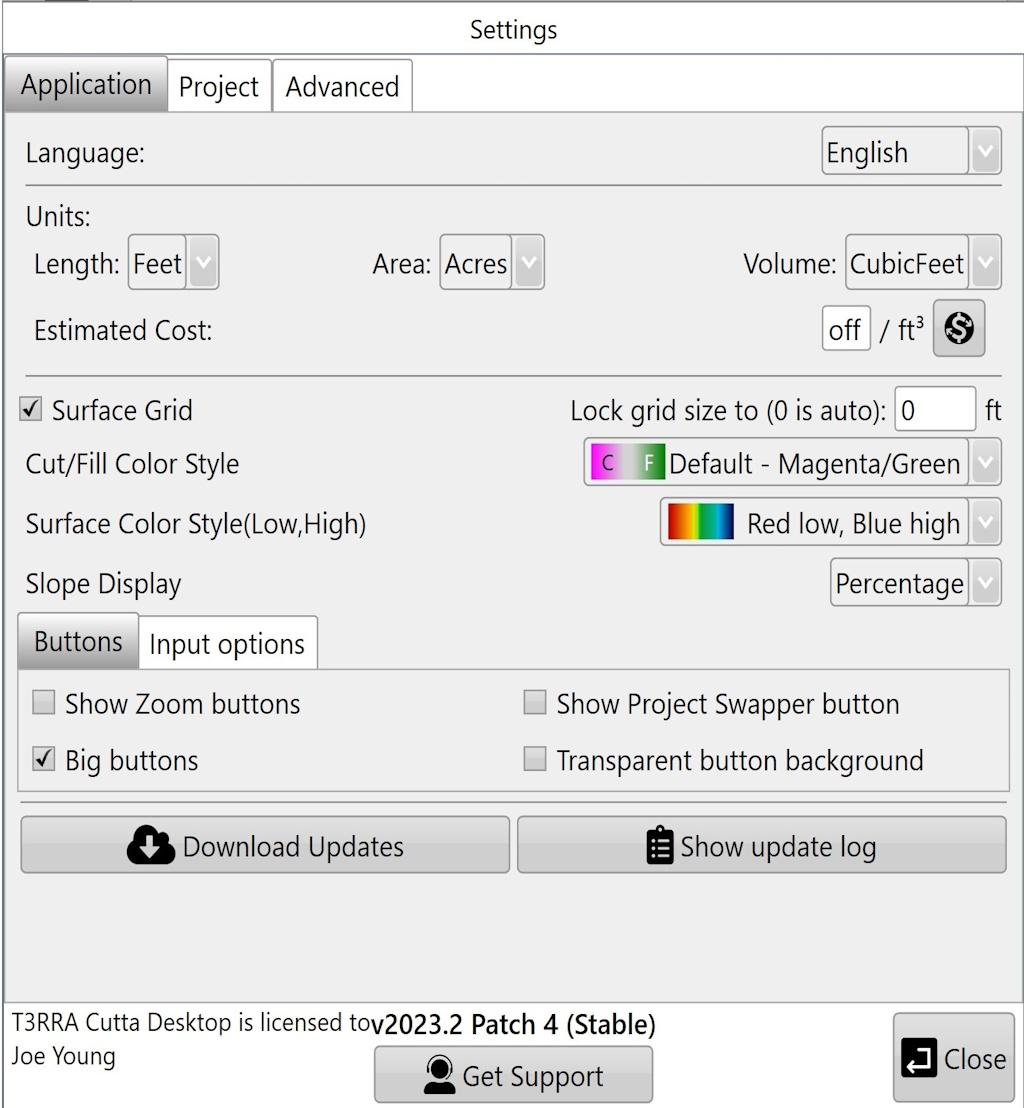
‘Language’ – Changes the language
‘Length’ - Changes unit of distance measurement.
‘Area’ - Changes unit of area measurement.
‘Volume’ - Changes unit of volume measurement.
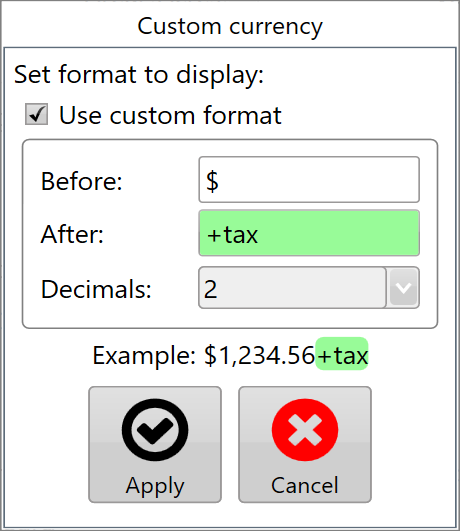
‘Estimated Cost’ — Set the estimated cost per volume of dirt moved. Click the button on the right to customize the currency format. Enter text before and/or after the amount, such as a currency code or other information; an example appears on the right.
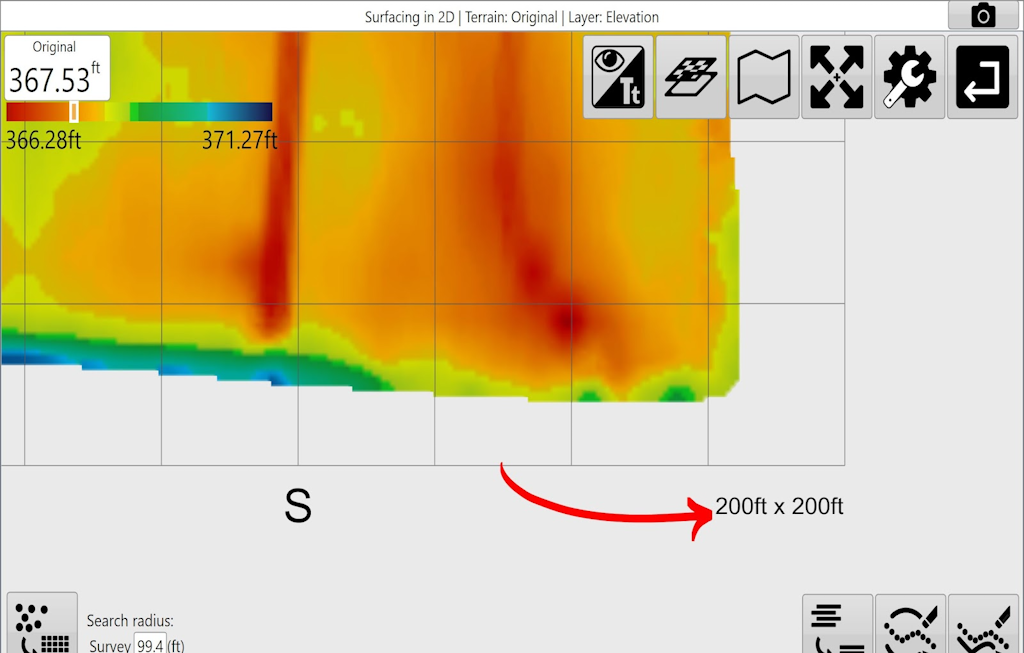
‘Surface Grid’ — Choose whether grid lines appear on the map. By default, the grid sizes itself to fit the field. The grid dimensions appear in the lower right corner of the scanned area.
‘Lock grid size to’ — Set the grid size manually, or leave this empty for automatic sizing.
‘Cut/Fill Color Style’ — Choose Magenta/Green (Magenta for cuts, Green for fills) or Red/Green/Blue (Red for cuts, Green for neutral, Blue for fills).
‘Surface Color Style (Low,High)’ — Choose the colors representing surface lows and highs from the drop down menu.
‘Slope Display’ — Display slope as a Percentage or a Ratio: 0.1% or 1/1000.
‘Show screen keyboard’ — Choose whether the keyboard opens automatically when needed.
'Show Project Swapper button'- Shows the project swapper icon.
‘Estimated Cost’ — Cost per cubic meter or cubic yard is calculated for cuts only. Currency is based on the current language.
'Download Updates' — Choose to update to the latest version when connected to the internet.
'Show update log' — View software update details.
For a youtube video tutorial on grid size override visit https://youtu.be/9rlCn1VuGlo or use your phone to scan this barcode

Project Tab
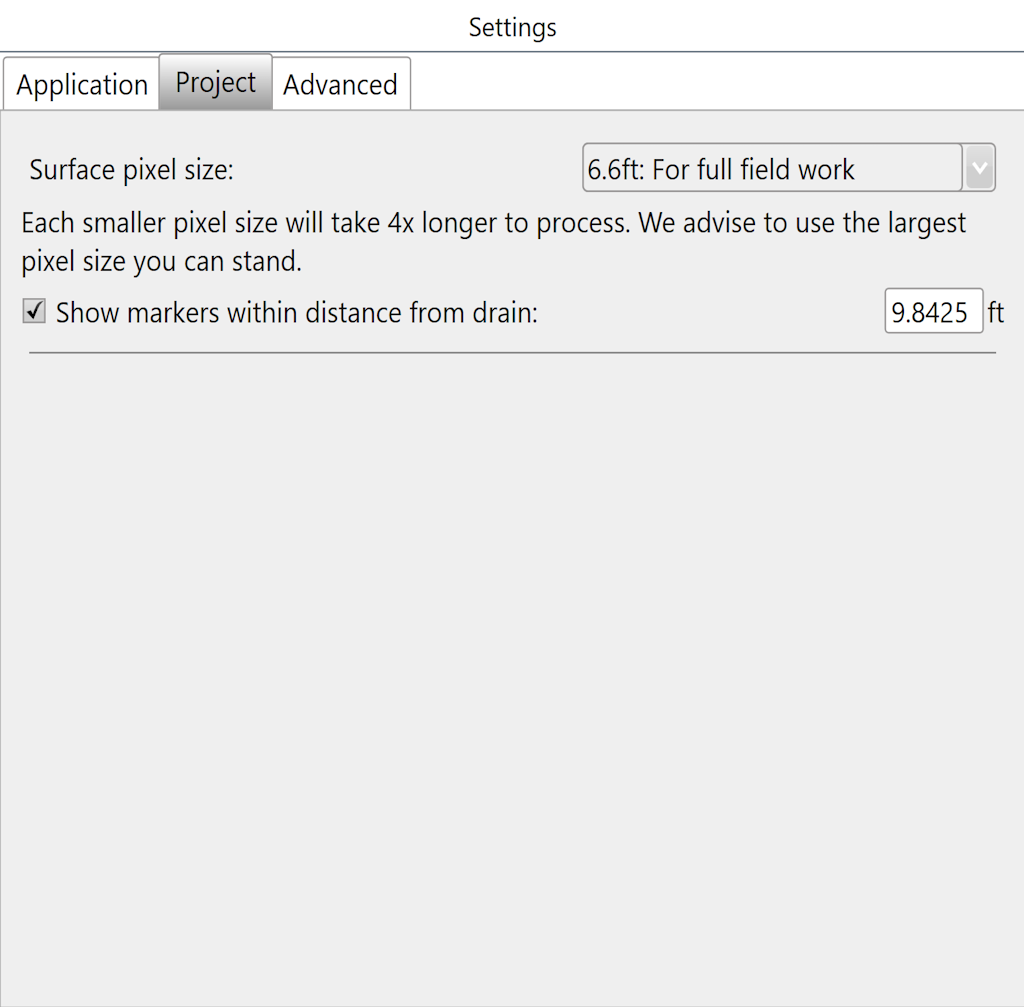
Changes in the Project tab are not represented in a project that is already open when you change the settings.
Surface Pixel Size — The default of 2 meters (~6 feet) is adequate for most purposes. Consider 1 meter or 0.5 meters when creating small interval contours or improving definition on drain batters/backslopes.
A field surface is a “raster”: a grid of elevation heights. Its cells, called “pixels”, have uniform edge sizes. Smaller pixels require more cells to cover the same area and provide a more precise elevation surface.
Points of interest
-
If pixel size is too large then the field surface will not appear smooth, and short range changes in elevation may not be adequately represented.
-
If the pixel size is too small, then the computer will have to work harder to process the data. Dividing the pixel size by two increases the amount of pixels by four.
Advanced Settings Tab
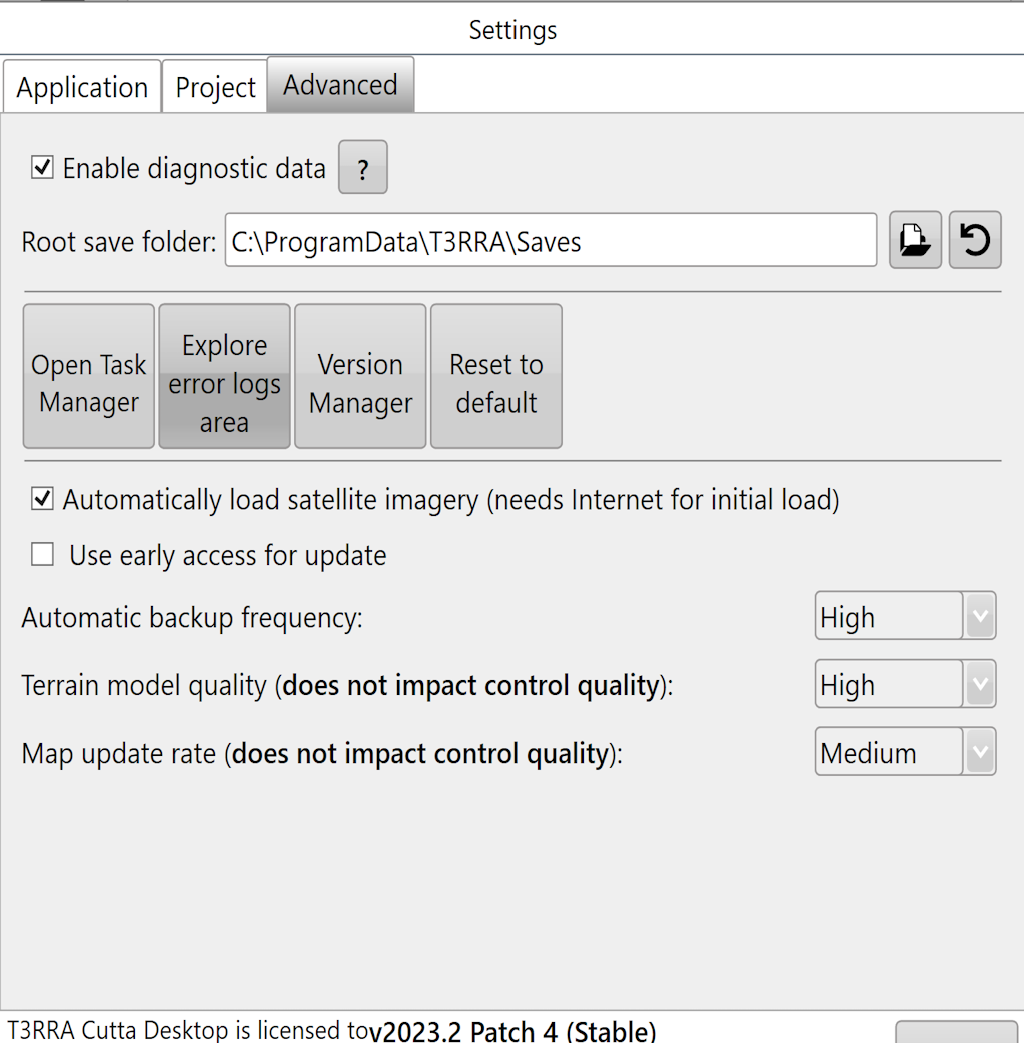
‘Enable diagnostic data’ — Keeping this enabled is highly recommended. The collected data helps us assist you if issues occur.
‘Open Task Manager’ — Open the computer's task manager tool to display all systems currently running on the computer.
‘Explore error logs area’ — Open the folder on the tablet containing all error log files. If you encounter an issue, we recommend sending us the latest file so we can identify and correct the cause quickly.
‘Version Manager’
Use Version Manager to revert to a previous version.
‘Reset to Default’ — Reset all settings to Default.
‘Automatic backup frequency’ — Choose how often T3RRA Software backs up your work from the drop down menu:
- Never — No backup save.
- Low — Backup save every 20 min.
- Medium — Backup save every 5 min.
- High — Backup save every 2 min.
‘Terrain model Quality’ — High is the default. This setting is most visible on surfaces in 3D. Lowering it may smooth out displayed details and depressions; they remain in the surface but are not represented in the 3D display.
‘Map update rate’ — Change how often the map updates during Surveying and Implementation.