
6.8 | Tandem Blade Behaviour
The Tandem Scraper profile allows Level COMMAND to control two trailing scrapers independently during the same grading operation.
Although each scraper is controlled separately, the overall operating workflow remains almost identical to a single scraper. Most setup, calibration and operating procedures described throughout this manual apply equally to both blades.

Independent Control
Each scraper maintains its own control solution based on its individual position and configuration.
Each scraper has independent:
- GNSS receiver configuration.
- Receiver offsets.
- Look-Ahead calculation.
- Blade Position calculation.
- Automatic Control output.
- Dynamic Cut & Fill Limiting.
This allows each scraper to respond correctly to the terrain beneath it, even though both are working as part of the same machine.
Shared Adjustments
Some operator adjustments intentionally affect both scrapers together.
For example:
- Blade Shift applies the same vertical offset to both blades.
- Project Zero applies to the entire machine.
- The selected Blade Control Mode applies consistently across the machine profile.
This keeps both scrapers working toward the same finished design while still allowing each blade to respond independently to local terrain.
 Monitoring Both Scrapers

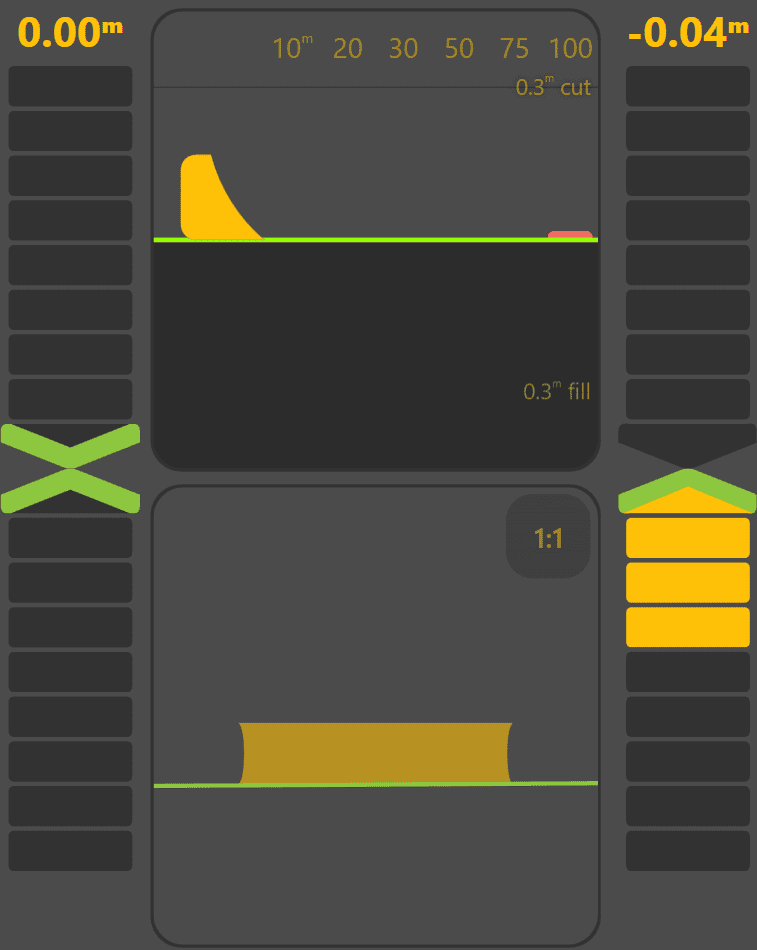
When using the Tandem Scraper profile, the Apply View displays two On-Grade Indicators—one for each scraper.
image.png
Each indicator displays the grading error for its respective scraper, allowing the operator to quickly confirm that both blades are tracking their Target Positions correctly.
Additional widgets are also available for monitoring the individual position and performance of each scraper where required.
Commissioning a Tandem Machine
Commissioning a Tandem Scraper follows the same process as commissioning a single scraper.
Each scraper should be configured and calibrated individually, including:
- GNSS configuration.
- Receiver offsets.
- Hydraulic calibration.
- Automatic Control tuning.
Once both scrapers have been configured, they operate together as a single machine profile.
Operator Tip: Treat each scraper as an independent Automatic Control system. Although both blades work toward the same finished surface, each one must be correctly configured and calibrated to achieve the best overall grading performance.
Chapter Summary: Throughout this chapter you've seen how Level COMMAND interprets the design surface, calculates the Target Position and continuously adjusts the implement to achieve a smooth, accurate finished result. Understanding these Automatic Control concepts makes it easier to interpret system behaviour and recognise how positioning, calibration, tuning and machine configuration influence grading performance. The next chapter builds on this foundation by covering the more detailed aspects of machine setup, calibration and advanced system configuration.