
6.5 | Position Quality & GNSS Validation
The accuracy of Automatic Control depends directly on the quality of the positioning information received from the GNSS receivers.
Every control decision made by Level COMMAND begins with a measured implement position. If that position is inaccurate, the calculated Target Position, Current Error and hydraulic commands will also become inaccurate.
Why Position Quality Matters
 Throughout this manual, Automatic Control has been described as continually comparing the Current Position with the Target Position.
This comparison is only meaningful if the Current Position accurately represents the true location of the implement.
Poor positioning can result in:
- Incorrect cut or fill values.
- Unnecessary hydraulic movement.
- Reduced grading accuracy.
- Poor finished surfaces.
- Unstable Automatic Control.
Although Level COMMAND continuously validates incoming positioning information, it cannot improve the accuracy of incorrect or poor-quality GNSS measurements.
Position Validation
Before Automatic Control is permitted to operate, Level COMMAND verifies that the received positioning information meets the configured operating requirements.
Typical validation checks include:
- Receiver communication.
- IMU availability (where fitted).
- Position update rate.
- RTK positioning quality.
- Position stability.
If one or more validation requirements are not satisfied, COMMAND Status reports the reason and Automatic Control may be prevented from engaging or may disengage until valid positioning information is restored.
Monitoring GNSS Operation
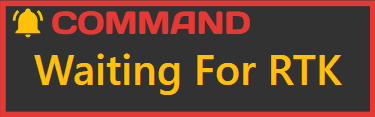
 During normal operation, COMMAND Status provides the primary indication of GNSS-related operating conditions.
Depending on the situation, COMMAND Status may report messages such as:
- Waiting for RTK before Automatic Control can be engaged.
- Loss of RTK if RTK positioning is lost during operation.
- Unstable GPS or IMU if the measured position or orientation becomes unreliable.
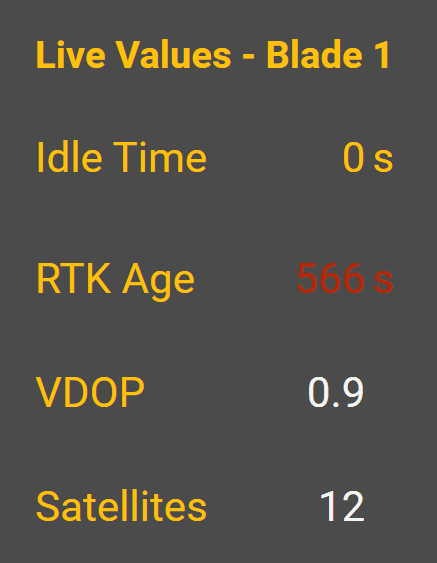
Additional live GNSS information can be viewed from:
More → COMMAND Settings → GPS Thresholds
This page displays live receiver information including RTK status, Satellite Count, VDOP and RTK Age, allowing the operator or dealer to confirm that the GNSS system is operating as expected.
When Further Investigation May Be Required



 If positioning quality remains poor, the cause often lies outside Level COMMAND itself.
Further investigation may be required if:
- RTK cannot be achieved.
- RTK is repeatedly lost during operation.
- Surveyed elevations appear inconsistent.
- Automatic Control repeatedly disengages due to positioning quality.
- COMMAND Status repeatedly reports GNSS or IMU warnings.
Depending on the installation, this may require checking:
- GNSS receiver configuration.
- Base station operation.
- Radio or correction link performance.
- Receiver antenna installation.
- Machine wiring and communication.
These components provide the positioning information used by Level COMMAND and should be operating correctly before investigating Automatic Control performance.
Good Operating Practice
For the best grading performance:
- Wait until RTK positioning has been achieved before beginning work.
- Verify COMMAND Status displays Ready to Engage.
- Investigate repeated RTK loss before continuing work.
- Confirm receiver and base station configuration if persistent positioning issues occur.
Operator Tip: If grading accuracy suddenly deteriorates, verify the quality of the GNSS solution before adjusting control settings or recalibrating the machine. Many apparent control problems are ultimately caused by poor positioning rather than incorrect Automatic Control settings.
Continue to 6.6 | Automatic Control Tuning to learn how Level COMMAND can be optimised once reliable positioning has been established.